Computational Materials Science Group
From atoms to polycrystals
Our group develops and couples atomistic, mesoscale, and continuum simulations to explain how dislocations, interfaces, and chemical complexity set the strength and ductility of metallic materials. Simulations are validated against experiments through collaborations at Clarkson and elsewhere.
Methods
Simulation toolkit
Molecular Dynamics
Atomistic simulation of dislocation nucleation, interfaces, and nanoindentation
Dislocation Dynamics
Discrete and continuum (CDD) models of dislocation transport and patterning
Crystal Plasticity
FFT-based elasto-viscoplastic polycrystal modeling (EVPFFT)
Finite Element Methods
Continuum analysis informed by lower-scale simulations
Scientific Machine Learning
Neural operator surrogates trained on high-fidelity simulation data
Experimental Validation
Collaborative testing and microscopy of the simulated materials
Current Research
Active projects

Mesoscale plasticity
Continuum Dislocation Dynamics Coupled with FFT Crystal Plasticity
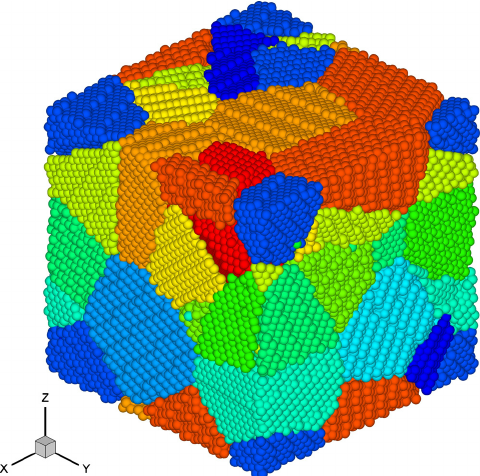
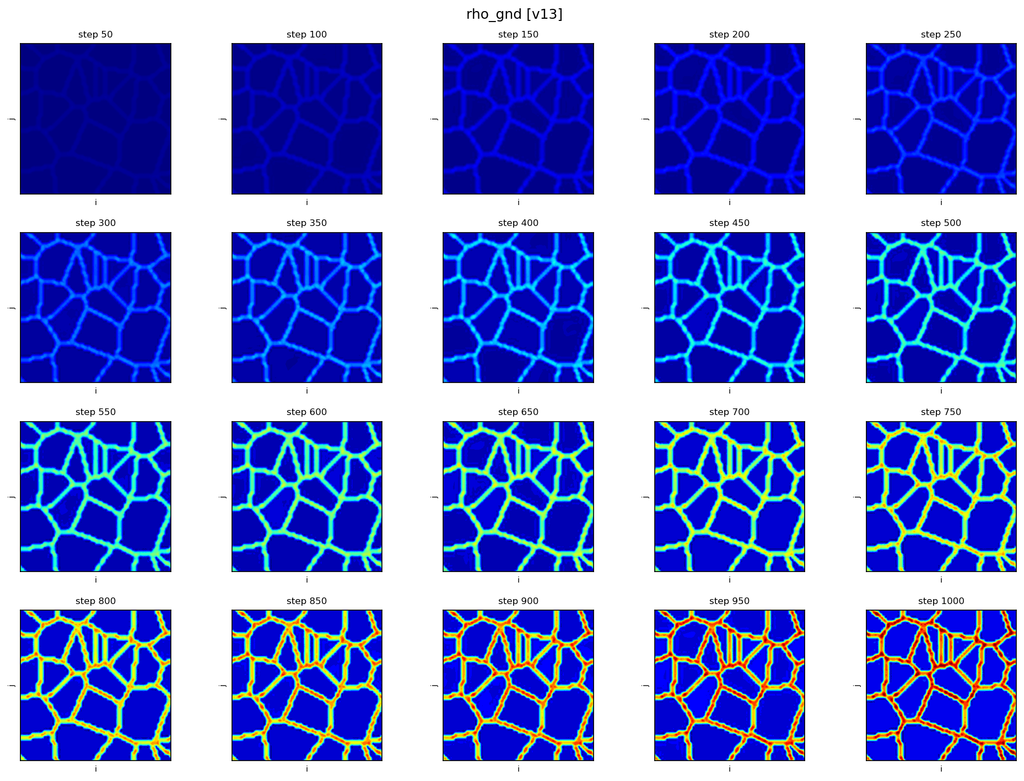
We couple an elasto-viscoplastic fast Fourier transform (EVPFFT) crystal plasticity solver with continuum dislocation dynamics (CDD) to resolve the evolution of dislocation density fields in polycrystals. Two- and three-dimensional implementations are compared against a reference formulation to quantify how dislocation transport and patterning control hardening.
Scientific machine learning
Neural Operator Surrogates for Polycrystal Plasticity
A three-dimensional Fourier Neural Operator (FNO), trained on EVPFFT-CDD simulations of polycrystalline copper, predicts the spatiotemporal evolution of stress, strain, plastic strain rate, and dislocation density fields from voxelized texture maps. The goal is to replace repeated solver calls in microstructure-sensitive studies with fast inference.
Atomistic simulation
Nanoindentation of High-Entropy Alloys
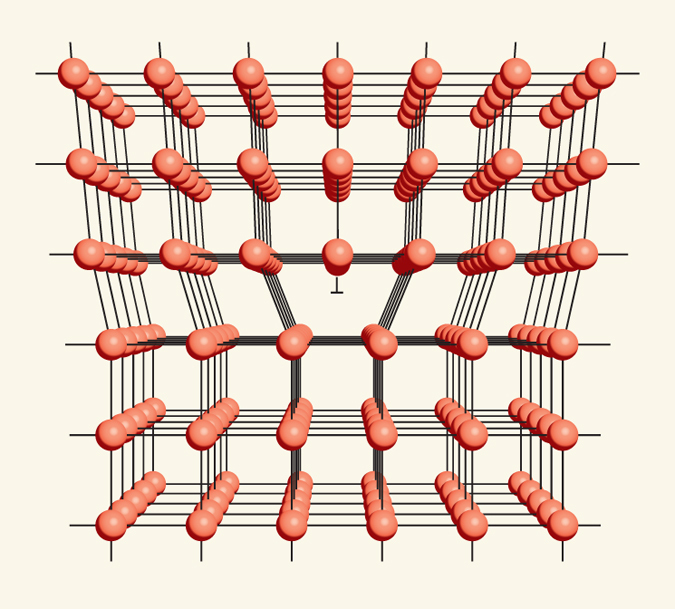
Molecular dynamics simulations of spherical nanoindentation examine incipient plasticity in high-entropy alloys: dislocation nucleation and evolution beneath the indenter, and the influence of local chemical composition on the load-displacement response.
Additive manufacturing
Deformation and Failure of Additively Manufactured High-Entropy Alloys
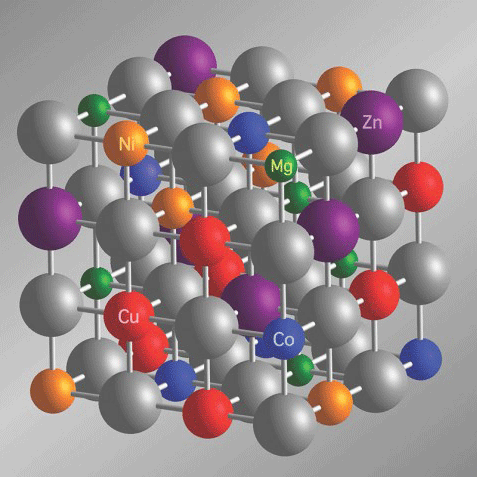
With collaborators in Clarkson MAE, the group studies AlCoCrFeNi high-entropy alloys produced by binder jetting and directed energy deposition, relating process-induced phase transformations and diffusional mechanisms to deformation mechanisms and failure behavior.
Ongoing Projects
Current funded research
Uncovering the strengthening mechanisms in nature-inspired metallic/ceramic multinanolayered coatings (CINT User Project 2026A0048)
PI: A. Bellou. Co-PIs: I. Mastorakos and G. Ayoub. Active through December 31, 2027. Center for Integrated Nanotechnologies (DOE Office of Science user facility, Sandia and Los Alamos National Laboratories).
Completed Projects
Past funded research
Strengthening Metallic Nanofoams Through Ligament Scale Materials Design (NSF CMMI-1634640)
Combined computational and experimental study relating foam geometry and individual ligament properties of composite Cu/Ni nanofoams to macroscopic strength, and developing techniques to manufacture, characterize, and test composite metal foams.
NSF Research Experiences for Undergraduates (REU) supplements CMMI-1724802 (2017), CMMI-1832755 (2018), and CMMI-1931637 (2019) funded undergraduate researchers on this project.
High-Entropy Alloys (NASA SBIR Phase II, via Additive Manufacturing Innovations LLC, 2020–2022)
Development of microstructure-informed, crystal-plasticity-based constitutive models for advanced high-entropy alloy systems.
AM-SIM: Computationally Efficient Simulation of Additive Manufacturing of Metals (STTR Phase I, Additive Manufacturing Innovations LLC)
2021–2022. Development of a next-generation, computationally efficient software tool for simulating additive manufacturing processes of metals.
Deformation and Failure in Nanoscale Multilayer Metallic Composites (DOE DE-FG02-07ER46435)
Co-PI with H.M. Zbib (PI) and D.F. Bahr, 2010–2014. Molecular dynamics and dislocation dynamics modeling of strength, size effects, and interface-controlled deformation mechanisms in Cu/Ni/Nb nanoscale metallic multilayers.
Multiscale Models and Methods for Nuclear Materials (Pacific Northwest National Laboratory)
Co-PI with H.M. Zbib (PI) and D.P. Field, 2009–2012. Multiscale modeling of irradiation-induced hardening in α-Fe and Fe-based alloys, linking atomistic simulations of dislocation–defect interactions to dislocation dynamics.
Earlier research themes
Deformation and size effects in nanoscale metallic multilayers and core-shell nanowires; multiscale modeling of irradiation-induced hardening in Fe-based alloys; dislocation-crack interactions using three-dimensional discrete dislocation dynamics; dislocation-density-based crystal plasticity of aluminum.
See the results
Journal articles, book chapters, and edited volumes from the group, grouped by year.