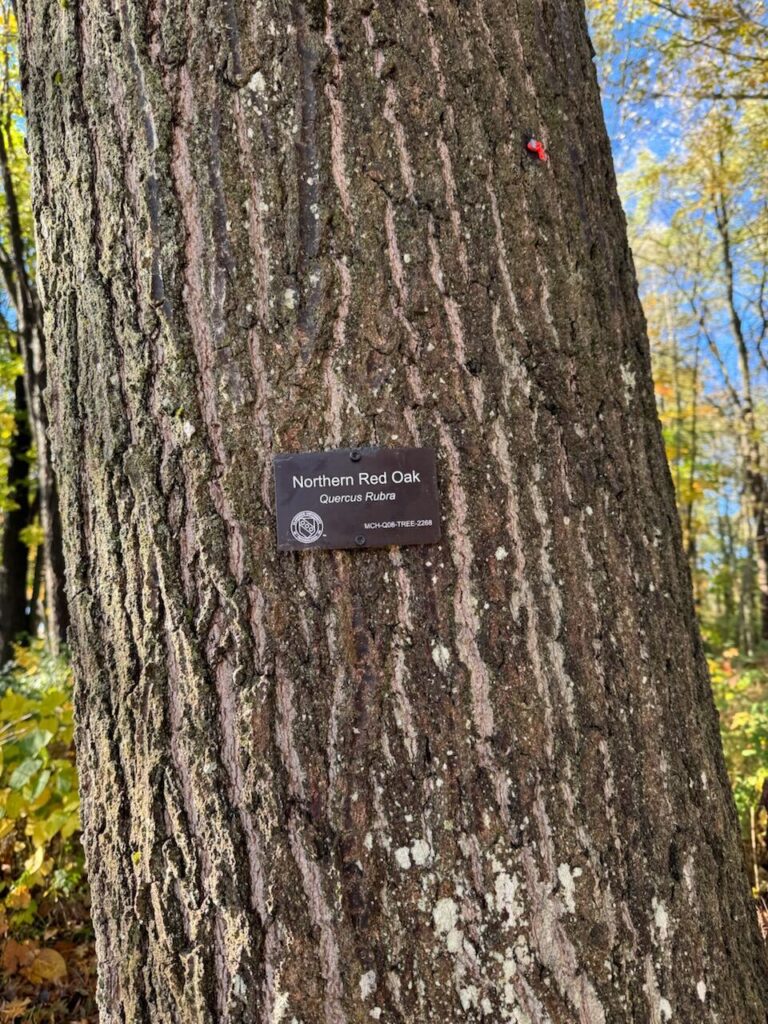
When exploring the Clarkson University Arboretum, you may notice that each tree has both a common name and a scientific name. While common names are easier to remember, they can vary widely depending on region, culture, or even personal experience.
For example, Carpinus caroliniana is known as:
- Musclewood
- American hornbeam
- Blue beech
This shows why relying solely on common names can be confusing — one tree can have multiple names, and one name can refer to multiple species.
Why Scientific Names Matter
1. Clarity & Consistency
Scientific names provide a universal language for identifying plants. Botanists, students, and nature enthusiasts around the world can know exactly which tree you’re talking about, no matter where they are.
2. Understanding Relationships
Scientific names reflect a tree’s genus and species, showing its genetic and ecological relationships to other plants. For example, trees in the same genus often share characteristics in leaves, bark, or habitat preferences, which can help you recognize patterns in the arboretum.
3. Supporting Education & Research
Using scientific names helps students, researchers, and visitors:
- Track growth and health of specific species
- Identify invasive vs. native trees
- Study ecological patterns and forest diversity
4. Preserving Knowledge for the Future
As climate change, invasive species, and urban development alter local forests, scientific names ensure that accurate knowledge about each tree is preserved for future generations.
How to Use Scientific Names in the Arboretum
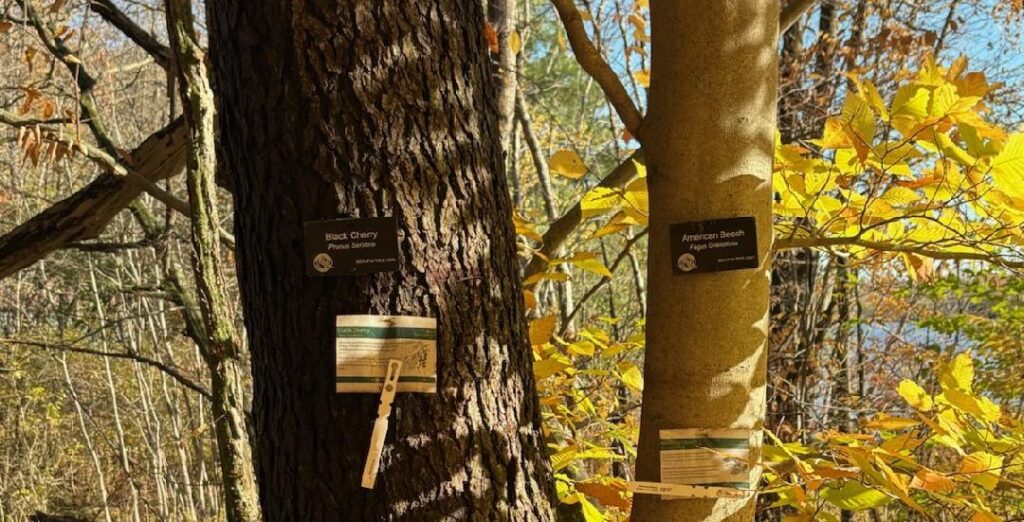
- Look for the 2-part Latin name on the tree signs along the Munter Trail.
- Notice the genus (the first word) — this groups similar trees together.
- Notice the species (the second word) — this identifies the specific tree.
- Compare different trees with similar genera to see patterns in leaves, bark, and growth habits.
By paying attention to scientific names, you can explore the arboretum with both curiosity and precision — deepening your understanding of our local forests and their ecological connections.
Examples of Differing Common Names
| Scientific Name | Common Names | Fun Fact / Note |
| Carpinus caroliniana | American Hornbeam, Musclewood, Blue Beech | Named “musclewood” because of its sinewy bark resembling flexed muscles |
| Acer saccharum | Sugar Maple, Hard Maple | Source of maple syrup; bright orange and red foliage in fall |
| Prunus serotina | Black Cherry, Wild Cherry | Produces small dark cherries eaten by birds and mammals |
| Pinus strobus | Eastern White Pine, Weymouth Pine | Can grow over 150 feet; state tree of Maine |
| Quercus rubra | Northern Red Oak, Champion Oak | Produces acorns that feed many animals; common hardwood species |
| Tilia americana | American Basswood, Linden | Flowers attract bees; wood used for carving and musical instruments |
| Acer platanoides | Norway Maple, European Maple | Non-native species; can outcompete native maples |
Reference: All About Scientific Names | Yard and Garden. (n.d.). Yard and Garden. Retrieved October 23, 2025, from https://yardandgarden.extension.iastate.edu/how-to/all-about-scientific-names